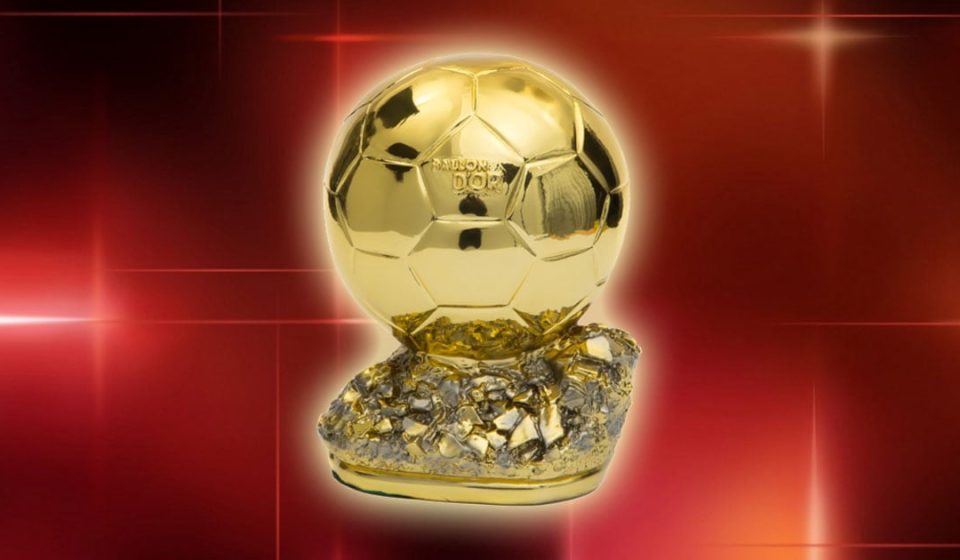

October is traditionally the month when the Ballon d’Or is awarded. Ahead of this significant event, let’s explore an alternative history: what if the Ballon d’Or had continued to be awarded exclusively to European players, as it was at the very beginning?
The Ballon d’Or was established in 1956 with the specific intention of honoring only European footballers. Consequently, legendary figures like Pelé, Garrincha, and Diego Maradona never had a chance to win the award, despite their global impact. It wasn’t until 1995 that the rules changed, allowing journalists to vote for any player worldwide. This shift immediately saw African star George Weah win the trophy, followed by Brazilian greats Ronaldo and Rivaldo, marking a new era.
But what if the organizers had stuck to the original European-only criteria? How would the award’s history have unfolded? Here’s a look at this alternate reality.
From 1995 to 2005, in the real world, George Weah won the Ballon d’Or in 1995, with Jürgen Klinsmann finishing second. In our alternate scenario, Klinsmann would have taken the prize. The German striker was at a career peak, having scored 20 Premier League goals for Tottenham and 29 in all competitions, enjoying immense popularity with over 150,000 shirts sold bearing his name. No other European player came close that year.
In 1997, the award went to the young Brazilian Ronaldo. Without him in the running, the trophy would have gone to either Yugoslav Predrag Mijatović (68 points) or the emerging Zinedine Zidane (63 points). The narrow gap between them suggests a close contest, with votes likely redistributed between these two.
By 1999, Rivaldo claimed the Ballon d’Or, with David Beckham finishing second. Beckham would undoubtedly have won the award if only Europeans were considered, especially after Manchester United’s memorable treble-winning season. Although Andriy Shevchenko was next in line, his points (64) were far behind Beckham’s (154), making him an unlikely contender.
In 2002, Ronaldo again won the Ballon d’Or, with Roberto Carlos taking second. Brazil’s World Cup triumph that year overshadowed others, but Oliver Kahn’s heroics in leading Germany to the final earned him third place. In our alternative timeline, Kahn would have been the rightful winner.
Finally, in 2005, Ronaldinho secured the trophy, with Frank Lampard (148 points) and Steven Gerrard (142 points) following. Both English midfielders were outstanding that year and would have been strong candidates for the Ballon d’Or under the original European-only rules.
Between 2006 and 2015, the Ballon d’Or was dominated by Cristiano Ronaldo and Lionel Messi. However, excluding South American players would have made Ronaldo the near-uncontested winner. According to this logic, he would have claimed eight Ballon d’Or awards during this decade—adding five to the three he actually won in 2008, 2013, and 2014. These additional wins correspond to years when he finished second behind Kaká (2007) and Messi (2009, 2011, 2012, 2015).
In all these cases, Ronaldo’s lead over the third-place candidate was substantial, indicating a clear lack of European rivals. The only close call was in 2013 when he edged out Franck Ribéry by just 4.5% of the votes, suggesting Ribéry might have had a chance if Messi’s votes were redistributed.
The only interruption to the Ronaldo-Messi dominance in this period came in 2010, when Spain won its first World Cup, and Andrés Iniesta and Xavi finished second and third respectively. Messi still won that year, but without him, one of these Spanish midfielders would have surely taken the prize.
From 2016 to 2025, the picture simplifies further. In this decade, only three Ballon d’Or wins went to non-Europeans, all to Messi, each facing fierce competition.
In 2019, Messi narrowly beat Virgil van Dijk by 686 to 679 points—a razor-thin margin. Many expected van Dijk to win that year, and without Messi in contention, the Dutch defender would have likely won comfortably.
A similar scenario unfolded in 2021, when Messi edged out Robert Lewandowski 613 to 580 points. Lewandowski’s record-breaking 41 Bundesliga goals that season sparked debates about the fairness of the outcome. Without Messi, Lewandowski would have been the clear winner.
Most recently, in 2023, Messi’s World Cup victory pushed him ahead of Erling Haaland, despite Haaland’s remarkable season tallying 36 Premier League goals, 12 in the Champions League, and 52 in 53 matches across all competitions. It seems the organizers favored Messi’s experience, anticipating Haaland’s future successes.
In all other cases this decade, European players have claimed the Ballon d’Or, and the trend is expected to continue. The main contenders this year are considered to be Lamine Yamal and Harry Kane. Unless Messi surprises once again, we’ll have to keep imagining what might have been if the Ballon d’Or remained a European-only award.