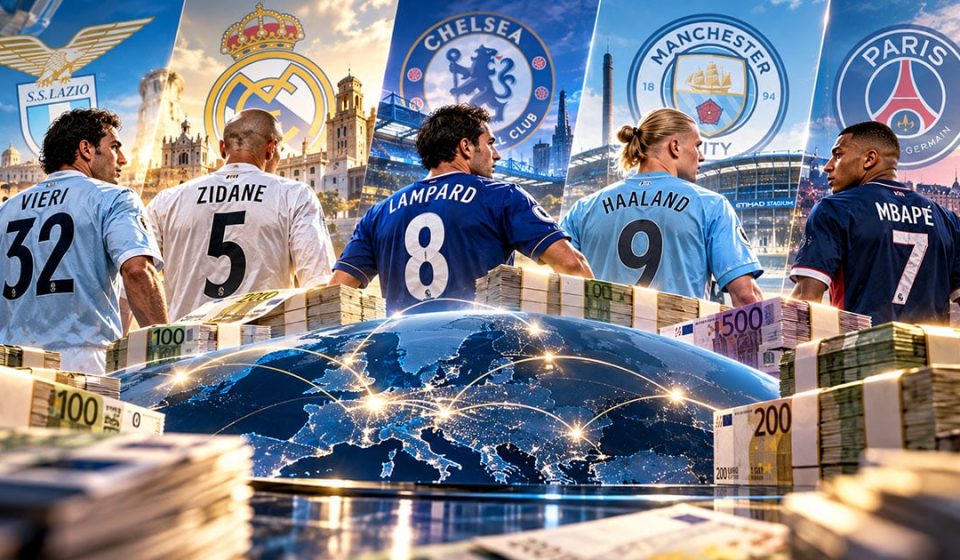

There was a time when Kyiv’s Dynamo spent €46 million in a single season on the transfer market. However, Shakhtar Donetsk had already realized that building a competitive squad requires annual adjustments. Interestingly, at the start of the century, the leader in transfer spending was not Real Madrid but Rome’s Lazio.
The greatest temptation for clubs with newfound financial power is often to spend impulsively. This approach has sometimes led to disastrous failures from which clubs have struggled to recover for years. Lazio’s early 2000s spending spree is a prime example of this phenomenon.
Breaking the €100 million and €200 million barriers: a timeline
According to Transfermarkt data, Lazio was the first club to surpass the psychological threshold of €100 million spent in a single season, achieving this in 1998-99 with a total just over €103 million. This was far from today’s spending madness; their priciest signing was Christian Vieri, acquired from Atlético Madrid for €28.4 million.
At that time and into the early 2000s, the epicenter of European football investment was Italy’s Serie A alongside Madrid’s Real Madrid. The latter was entering the era of the first “Galácticos,” marked by high-profile signings. Yet, Real’s management showed some patience initially, making controversial moves like signing Luís Figo, then breaking records with the €77.5 million transfer of Zinedine Zidane. This was followed by the arrivals of Ronaldo and David Beckham.
Looking back, it’s striking to see clubs like Parma, Deportivo La Coruña, and Middlesbrough among the top spenders—a reflection of their financial peaks before eventual declines or bankruptcies.
The €200 million milestone was crossed in 2009 when Florentino Pérez returned as Real Madrid president. The club launched an unprecedented transfer campaign, investing around €258 million to sign Cristiano Ronaldo, Kaká, Karim Benzema, and Xabi Alonso. This leap set new standards for assembling European elite squads, turning the €200 million mark from an anomaly into a regular budget benchmark for top clubs.
Capital revolutions: the rise of Chelsea, Manchester City, and PSG
In September 2009, UEFA raised alarms as more than half of 655 clubs were operating at a loss. This led to the introduction of Financial Fair Play regulations, which impose strict penalties for breaches—provided the 114 points of accusation can be proven.
However, the story here is different. The “Chelsea era” began in July 2003 with the arrival of oligarch Roman Abramovich. His ownership quickly rewrote the rules of the European transfer market, spending around €170 million on a squad overhaul. New signings included Hernán Crespo, Juan Sebastián Verón, Claude Makélélé, Damien Duff, and Adrian Mutu. The following 2004-05 season under José Mourinho saw further investment exceeding €160 million, bringing in Didier Drogba, Ricardo Carvalho, Paulo Ferreira, and Arjen Robben. These outlays yielded trophies, although Chelsea’s first Champions League campaign ended in personal heartbreak for John Terry.
This set a precedent, and in September 2008, Manchester City’s investment spree began. Sheikh Mansour made a statement on deadline day by signing Robinho, pushing the 2008-09 season spending to €157 million. A year later, the club fully asserted itself as a market powerhouse, spending €147 million on Carlos Tévez, Emmanuel Adebayor, Kolo Touré, and others. While these figures now pale compared to current spending, this decade marked the start of relentless transfer market pressure.
Shortly after, Qatar Sports Investments fueled Paris Saint-Germain’s financial rise beginning in 2011-12. Initially reminiscent of Lazio’s style, PSG’s first major signing was Javier Pastore for a French league record €42 million. Within a year, PSG had cemented itself among Europe’s top three spenders, investing roughly €150 million on Zlatan Ibrahimović, Thiago Silva, Ezequiel Lavezzi, and Lucas Moura. Their expansion peaked in 2017 with the record-breaking transfer of Neymar and the acquisition of the young but already established Kylian Mbappé.
Money without guarantees
The popular belief is that “money is essential to build a competitive team.” Yet, financial muscle alone offers no guarantees. A recent example is the absolute record for single-season investment held by Chelsea during the 2022-23 campaign, following the club’s acquisition by the Clearlake Capital and Todd Boehly consortium.
Chelsea’s combined summer and winter transfer spending exceeded €630 million. This record-breaking spree included signing Enzo Fernández (€121 million), Wesley Fofana (€80 million), Mykhailo Mudryk (€70 million plus bonuses), and Marc Cucurella (€65 million). The outcome was a bloated squad, managerial instability, and poor results. Notably, three of those four players have already left Chelsea, and Fofana’s market value has dropped to €28 million.
The Ukrainian footprint among Europe’s top 20 spenders
What about Ukrainian clubs? Their presence among Europe’s biggest buyers was localized but notable during the Ukrainian Premier League’s financial peak between 2007 and 2014. The main contributors were Shakhtar Donetsk and Kyiv’s Dynamo.
Shakhtar first approached Europe’s elite spenders in 2007-08, investing around €55 million to strengthen their Brazilian contingent and bolster the squad for the Champions League. That season, the “miners” signed Nery Castillo (€20 million), Willian (€14 million), Ilsinho (€10 million), and Cristiano Lucarelli (€7.5 million).
The 2013-14 season marked the peak of Ukrainian spending, with two UPL representatives among the continent’s most generous buyers. Shakhtar reinvested proceeds from sales of Fernandinho, Willian, and Henrikh Mkhitaryan, spending €71 million on a Latin American influx including Bernard (€25 million), Fred (€15 million), Fernando (€11 million), and Wellington Nem (€9 million). Simultaneously, Kyiv’s Dynamo conducted its most aggressive campaign ever, allocating about €46 million on transfers such as Dieumerci Mbokani (€11 million), Younès Belhanda (€10 million), Aleksandar Dragović (€10 million), and Jeremain Lens (€9 million).
Earlier, in the 2010-11 season, four Ukrainian clubs collectively spent over €106 million, with expenditures fairly evenly split: Shakhtar (€28.4 million), Dnipro (€28.3 million), Metalist (€26 million), and Dynamo (€24.5 million). This transfer strategy directly influenced their UEFA coefficient rankings, as Ukraine confidently entered the top 10.